Reopening during and after the pandemic is fraught with challenges but laden with opportunities. For marketers, it's an ideal time to take advantage of new marketing and communications approaches to differentiate your brand for the "new normal" in your industry. Read the full article at MarketingProfs
Source MarketingProfs Daily: Marketing Strategy https://ift.tt/30wXYhd


الخميس، 6 أغسطس 2020


The Keys to Effective Off-Site Search Engine Optimization [Infographic]
Effective SEO isn't just about improving your website structure, performance, and content; it's also about signaling the right things to search engines via external pages and platforms. Read the full article at MarketingProfs
Source MarketingProfs Daily: Search Engine Marketing https://ift.tt/3gB4byi
Source MarketingProfs Daily: Search Engine Marketing https://ift.tt/3gB4byi
الأربعاء، 5 أغسطس 2020
Google extends lead forms to YouTube, Discovery campaigns
There are more contact fields, questions by vertical and new ways to automate customer data imports into Google Ads.
Please visit Marketing Land for the full article.


Source Marketing Land - Internet Marketing News, Strategies & Tips https://ift.tt/33vHRSY
Please visit Marketing Land for the full article.
Source Marketing Land - Internet Marketing News, Strategies & Tips https://ift.tt/33vHRSY
Release Notes: Amperity partners with Infutor
CDP links up with consumer data partner.
Please visit Marketing Land for the full article.

Source Marketing Land - Internet Marketing News, Strategies & Tips https://ift.tt/3kiHp0n
Please visit Marketing Land for the full article.
Source Marketing Land - Internet Marketing News, Strategies & Tips https://ift.tt/3kiHp0n
Strengthen your competitive analysis strategy with social listening
There is a universal (and obvious) truth in business: in order to win, you need to beat the competition. And in order to beat them, you need to understand them. This means learning about their strengths and weaknesses–both in business and marketing–and understanding how your audience perceives them. For social marketers, gaining these competitive insights has become an increasingly critical tool to help them differentiate their brand and strengthen their share of voice (SOV) in the conversation.
With this in mind, we’re excited to share that we’ve released a powerful new template for Competitive Analysis in Sprout Listening. This update provides a comparative insights view that makes it much easier to compare and contrast your social performance with competitors across key metrics, including SOV, engagement and sentiment. These metrics are crucial for understanding who is dominating the conversation, how your audience feels about your competitors and, most importantly, how you stack up against them.
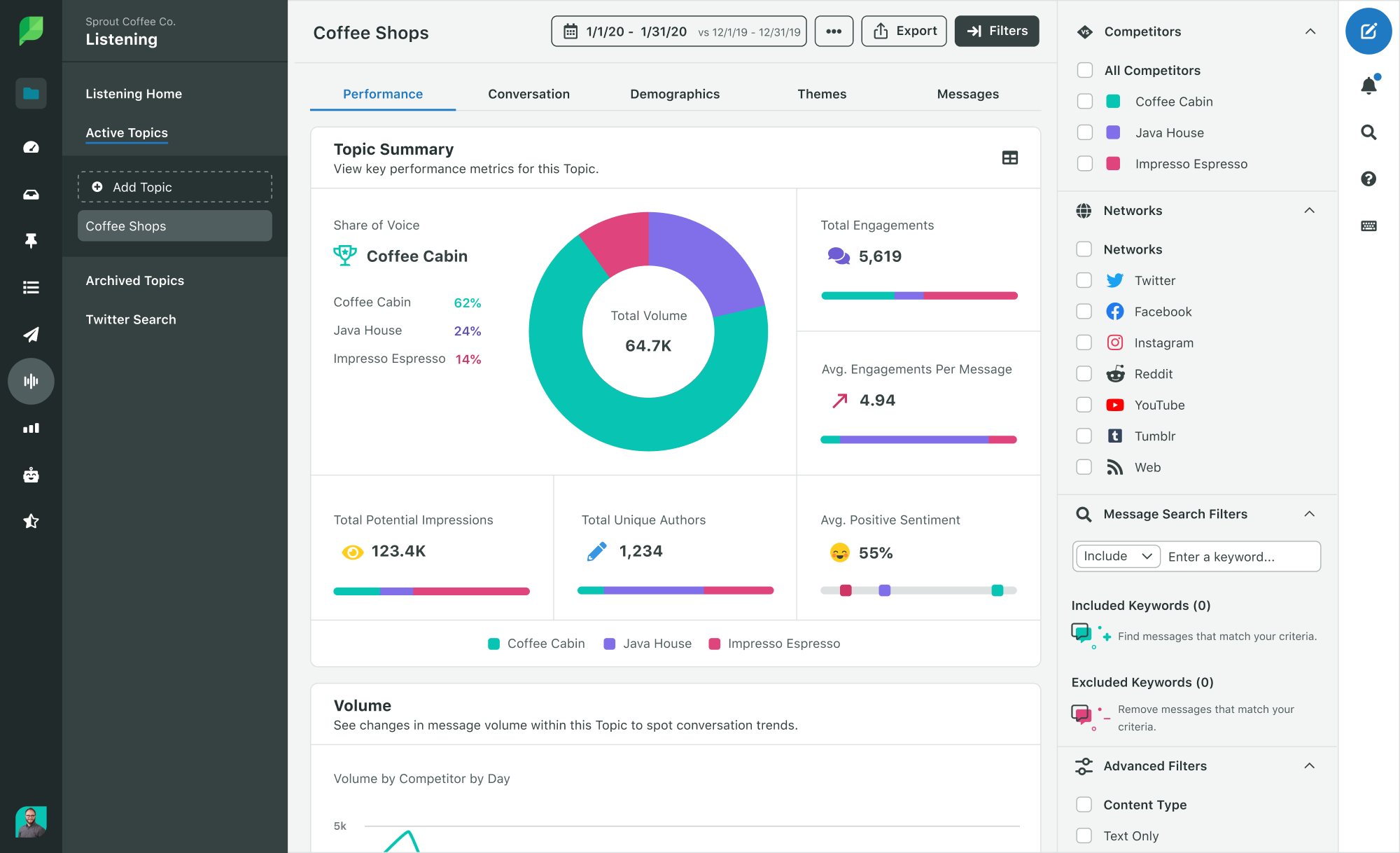
While Listening gives you insights into competitors’ organic presence in broader conversations across social (aka “earned content”), our Competitor Reports provide performance data for content published by your brand across social platforms (aka “owned content”). Together, these tools offer a holistic solution to understand where your brand stands against the competition and where you should be investing your social efforts. Below we break down the key strategic elements of a strong competitive analysis strategy and discuss how you can leverage the Sprout platform to strengthen your brand position and grow your share of voice.
- Benchmark your social performance
Benchmarking is the foundational step in a good competitive analysis strategy, as it helps you gain critical context to understand your social performance and brand health. Without it, you’re essentially measuring data in a silo. For example, let’s say you double your audience engagement over a six month period. That’s great news, right? What if you then learn that your top competitor has quadrupled their engagement over the same period? It certainly impacts the way you view your own performance and likely will motivate you to learn how your competitor achieved such impressive results.
When benchmarking your social performance, there are two key aspects that you need to examine: owned content and earned content.
Owned content refers to content that brands publish from their own social profiles. Sprout’s Competitor Reports, available in our Premium and Advanced plans, give you in-depth data around your competitors’ content performance within major social platforms, including Twitter, Facebook, and Instagram. You can track key metrics like audience growth, post volume and engagement, and then filter down by date range, profile and content type for a more focused analysis. This gives you a better sense of how your competitor’s social content is resonating with your shared audience and how strongly they’re performing within individual platforms, which we will discuss in more detail in the next section.
On the other hand, earned content refers to brands’ organic mentions in broader social conversations, so this is where listening comes into play. Our new Competitive Analysis template makes it easy to compare SOV data, which is one of the most powerful social metrics you can use to gauge your brand’s competitive position and industry relevance. You can also analyze sentiment scores and trends to see how your audience feels about your competitors (and relevant topics) compared to your own brand. As you track SOV and sentiment, you can now filter down by competitor to analyze smaller subsets or conduct a head-to-head comparison, in addition to using existing filters such as network, profile, content type and demographics.

Once you compile this benchmarking data, you will have much more meaningful context for your brand health and content performance. These insights will help you understand where you’re performing well and where you should be investing more efforts to improve your social game.
- Learn what content works—and what doesn’t
The next step in your competitive strategy is to analyze your competitor’s content and how it’s performing to learn what resonates with your audience and industry.
Since each network is unique, start by looking at content across each individual social network. For example, the curated photo and video content that performs so well on Instagram may not have the same resonance on Twitter, where content is geared more towards short-form text dialogue and timely updates. Using Sprout’s Competitor Reports, you can evaluate in-depth content performance and engagement data for your competitors across Facebook, Twitter and Instagram.

It can also be helpful to evaluate your competitor’s content by a specific topic or campaign. That’s where social listening comes back into play. Our Competitive Listening template helps you identify top keywords and hashtags in competitor-related conversations, so you can easily spot common topics and industry trends. You can then click into the Messages tab for more detailed insights on individual posts, including the content, profile and engagement data.

- Discover new business opportunities
Beyond just measuring your brand health and marketing performance, social listening is an extremely powerful tool for gaining insights around industry trends, product feedback and customer pain points. When it comes to your competitive strategy, you can and should be leveraging these listening insights to spark new marketing ideas and identify product and business opportunities that will help you differentiate your brand.
James Hardie®, a leading brand in the building materials industry, is a great example of leveraging listening to improve business strategy across an organization. Using Sprout Listening, James Hardie is able to engage in audience and trend analysis, research sentiment regarding their products, identify industry influencers and conduct competitor comparisons. Even better, they can take the insights they uncover and use them to optimize their business operations outside of digital marketing.
“Not only is it good from a brand health and marketing angle, it’s also important information we can pass on to our sales teams and product teams. We can find trends and common themes that come up in conversations. We can identify not only our own brand advocates, but brand advocates for our competition. It’s been good from so many perspectives.”
– Bridget Kulla, Senior Digital Marketing Manager at James Hardie
Get started with competitive analysis today
No matter your business size or industry, competitive analysis is one of the most important tools you should be utilizing to differentiate your brand and grow your share of voice. Sprout’s platform makes it easy to benchmark your performance, analyze competitor content and gain deeper insights around your industry, products and customers. Not only will these insights help improve your marketing strategy, but they will also provide significant business value across your organization.
Visit our website to learn more about Sprout’s competitive analysis offering.
This post Strengthen your competitive analysis strategy with social listening originally appeared on Sprout Social.


Source Sprout Social https://ift.tt/2BZRY7i
Strategies for B2B Executives: How to Boost Content Marketing ROI and Impact
Though marketing teams can produce content marketing that resonates with prospects and customers, executive-team buy-in and participation can elevate their efforts and open more opportunities to attract higher numbers of qualified leads. Read the full article at MarketingProfs
Source MarketingProfs Daily: Marketing Strategy https://ift.tt/2Dzq3vq
Source MarketingProfs Daily: Marketing Strategy https://ift.tt/2Dzq3vq
10 Simple steps for a smoother work vacation (with template)
If you’re part of a busy team at work, preparing for vacation can be a huge drag.
Ironic, right?
However, the rate at which workers today neglect to take time off is alarming. This is especially true as more and more people are battling burnout in the office.
Consider that over 55% of workers didn’t actually use their allotted PTO in 2018. That translates into over $65 billion in benefits gone to waste.
Yikes.
Listen: the stress of preparing for PTO shouldn’t overshadow your ability to recharge and enjoy a vacation. In the wake of COVID-19, remote workers need more help than ever when it comes to disconnecting and creating space for time off.
The 10 steps of preparing for PTO (without totally stressing out)
Rather than look at your upcoming PTO as the source of endless to-do list, we’ve broken down the process into ten simple steps.
Below are ten essential things to do before leaving for vacation (minus the freakout). We’ve also translated these steps into a template you can use to easily boil down the essential info for your coworkers here:
1. Decide whether or not you’re going to fully unplug
First things first: are you going to totally go off the grid or take some of your work with you on vacation?
There is no right answer here. Sure, the mental health benefits of an unplugged vacation are well-documented.
But depending on your role or even company policies, unplugging altogether might not be possible.
Given that a staggering 78% of people say that they’d only take a vacation if they still access their work, doing at least something while away from the office is the norm (for better or worse).

Either way, we recommend setting some ground rules for yourself to avoid constant being on-call while vacationing.
For example, try to make it clear to coworkers that you’ll only be available via email and will only respond to messages during the morning or evening hours. You could likewise say that you’ll use Slack to check-in but phone calls and emails are off-limits.
2. If possible, plan your PTO in advance
This might seem like a no-brainer, but giving yourself and your colleagues a heads up prior to PTO is a win-win.
How so? You win because you’re able to start working ahead, making adjustments to your meetings or campaigns. Meanwhile, your coworkers win as they’re able to manage their expectations and aren’t blindsided by a bunch of work falling into their laps. An easy way to communicate this might be during a team meeting a couple of weeks out, or with a calendar invite sent to those that need to know.
Ideally, preparing for a vacation shouldn’t mean scrambling and panicking last-minute. Remember that PTO impacts your coworkers’ schedules in addition to your own. Even a couple of days’ worth of notice will be much appreciated.
3. Delegate tasks to coworkers you trust
Don’t make the mistake of leaving a to-do list for your coworkers and calling it a day.
Instead, talk to them. Preferably in person and then followed with a confirmation email for the sake of accountability. Let them know what you need help with.
Actual conversations will uncover potential questions that your colleagues might have about what needs to be done. You should obviously hand off tasks to people that you trust, but also people who aren’t overwhelmed with work themselves.
As a side note, you should give your coworkers some credit! Although some of us might feel that we’re completely irreplaceable at work, the world’s (most likely) not going to end because you’re taking time off.
4. Make sure your team has access to the tools they need
Picture this: you’re a social media manager that’s left your company Twitter account in the hands of a junior employee.
But when it comes time to conduct your weekly Q&A, they’re locked out of all of your social accounts. No posts, no questions. Nothing.
This again speaks to the need to talk to your coworkers and make sure that they have the appropriate tools and permissions to pick up the slack. For example, Sprout allows you to grant specific access and permissions to team members without having to sift through a bunch of log-ins.

Much like having a social media approval process, it’s important that your coworkers test-drive any tools and double-check any passwords while you’re preparing for vacation versus after the fact.
5. Automate and queue up as much as you can beforehand
This tip is especially important for those working in social media but also applies to email or ad campaign managers as well.
For peace of mind, you should try to pre-schedule your campaigns while you’re preparing for PTO. Prepping messages in advance means you already have the final say on creatives and copy: all you need to do is pick a date and time for your campaigns to fire off.
If you’re a social media manager, you can use scheduling tools to queue up your posts based on your company’s calendar. Sprout’s platform also allows users to manage assets such as photos and captions, perfect for making quick edits or changes if necessary.

6. Put together a brief out of office autoresponder
Putting together an out of office autoresponder does double duty of managing people’s expectations while also letting them know exactly when you’ll be available again (or how else to get in touch).
If your inbox is off-limits during vacation, you should make it clear. The good news is that you can easily set up an out of office autoresponder in Gmail in a matter of minutes.

Keep in mind that out of office replies don’t need to be particularly lengthy or detailed. Here’s an example of an effective out of office message that gets straight to the point:
Hello,
Thank you for your message.
I am out of the office [date] through [date] with no access to email. I will respond when I return on [date].
Thank you,
[Your name]
Short, sweet and to-the-point. See how that works?
Although you can definitely add some personality to your out of office messages, a blunt tone is perhaps best for getting the point across that you aren’t available.
7. Make your PTO visible to the rest of your company
Any tasks you can take off of your plate while preparing for vacation is a plus.
Case-in-point, you shouldn’t have to chase after people to let them know that you’re taking some time off. Beyond talking to people in-person and setting up an autoresponder, consider including your PTO as part of your company calendar.
If your company uses Slack, you can make your PTO public through the platform’s calendar feature. 
Slack also allows you to create event reminders for your employees’ PTO. This is particularly useful for larger teams or instances where someone from another department (sales, HR) is trying to get in touch with you.

Making your PTO public isn’t just specific to Slack, by the way. The same logic applies to Google Calendar or any other tools your team uses to manage schedules.
8. Encourage your team to track their progress with project management tools
Let’s say you have trouble letting go at work and want to make sure your projects are running smoothly in your absence.
Hey, no problem. That’s exactly where project management tools like Trello can come in handy. With a Kanban board, you can clearly see who’s working on what and how a project is moving along.
This is useful not only for you if you’re looking to monitor your team’s progress while away, but also encouraging accountability for individuals working as a team.

Having this sort of visual progress report also makes your life much easier when you return from vacation as you can see what’s going on in your department at a glance.
9. Don’t sweat it if you don’t get everything done (both before and after you return)
Don’t put too much pressure on yourself to have everything “perfect” in terms of your vacation planning.
After all, emergencies happen and so do last-minute vacations. If you find yourself suddenly out of the office and unable to stick to your PTO plan, don’t panic.
And similarly, don’t force yourself to achieve “inbox zero” as soon as you get back. Simply following the tips above means that your workload should be more manageable, anyhow.
10. Make sure you leave your workspace spotless
Perhaps the last thing you do while preparing for a work vacation is to clean up your desk.
Simple enough, right? This isn’t just a courtesy for your coworkers, though, and it can benefit remote workers too. Cleaning is also beneficial to you mentally as it’s easier to hit the ground running with a sort of “blank slate” when you’re back to work after vacation.
If nothing else, cleaning is a way to step away from the phone or your inbox as you’re prepping to take time off.
https://t.co/4OFWfgsFmG pic.twitter.com/dKyt7jZmEj
— Minimal Setups (@MinimalSetups) July 16, 2020
And with that, we wrap up our guide!
What does preparing for vacation look like for you?
If you want to actually enjoy your vacations and ensure that your coworkers can easily pick up the reins while you’re gone, a bit of planning goes a long way.
By following the vacation checklist above, you can take your PTO with peace of mind. Download our template to put these steps into practice for your next vacation:
Being able to plan effectively is a key skill for social media managers. Speaking of which, make sure to check our guide to essential social media skills to see how else you can level up as a marketer.
This post 10 Simple steps for a smoother work vacation (with template) originally appeared on Sprout Social.


Source Sprout Social https://ift.tt/33uD9F6
How to find content topics ahead of their boom
News agenda The news agenda often has an impact on future content trends and is therefore great for spotting upcoming themes. If we take recent times, for example, a health pandemic perpetuating the news has led to an increase in knock-on effect topics such as mental health, working remotely and home exercising. Using these insights, […]
The post How to find content topics ahead of their boom appeared first on Builtvisible.
Source Blog – Builtvisible https://ift.tt/3fqOxUN
How search data can inform larger online business decisions
Decision makers in their respective silos are generally unaware of the value in the data Google shares so it’s your job to disperse this knowledge across your organization.
Please visit Marketing Land for the full article.

Source Marketing Land - Internet Marketing News, Strategies & Tips https://ift.tt/2Dxi41Y
Please visit Marketing Land for the full article.
Source Marketing Land - Internet Marketing News, Strategies & Tips https://ift.tt/2Dxi41Y
الاشتراك في:
الرسائل (Atom)