Looking for ways to create useful social media content from your videos, live video, and podcasts? Wondering how to easily transform that content for social media? In this article, you’ll discover how to repurpose video and audio into multiple formats you can share on your social media channels. Have Your Tech in Place Creating content […]
If you’re not yet using trending hashtags on Twitter to their fullest potential, you could be missing out on a lot of prospective impressions and engagement. In other words, it could be a missed opportunity to attract a relevant audience on the platform. So even if you know what to Tweet, you might not get optimum visibility for your Tweets without the right hashtags.
This post gives you a detailed guide on Twitter hashtags, why you need them for your brand, when you should use them and how you can find the best ones. Let’s get started.
Why are Twitter hashtags important?
Hashtags are a combination of keywords or phrases preceded by the # symbol, excluding any spaces or punctuations. For example, if you put the # symbol in front of the words “social media,” it becomes a hashtag #socialmedia.
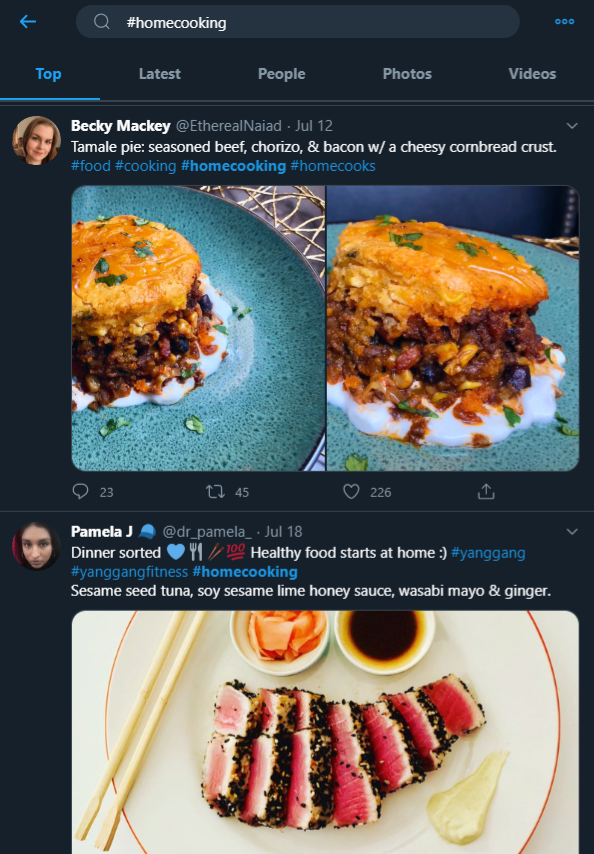
Hashtags help group Tweets and conversations around a similar topic so people can easily find and follow what interests them. So when someone clicks on or searches a specific hashtag, they will be able to find all the profiles and public posts that use that hashtag. For instance, if I search for #homecooking, I can see plenty of posts of home-cooked meals.
So when you use relevant hashtags with your Tweet, there’s a good chance it will appear when people search that hashtag or topic. And the more visible your Tweet is, the more likely people will engage with it.
Engaging in trending Twitter hashtags could also help you attract a highly relevant audience that is interested in what you have to say. Some might discover your products through these hashtags, while others might start following your brand.
When to use Twitter hashtags for your brand
The key to Twitter hashtags is to use them correctly rather than just blindly using them and hoping for the best. This is especially true for those running brand social media accounts as it requires taking a calculated approach for proper hashtag marketing.
Check out when you should use Twitter hashtags for your brand:
1. Tweeting about events and conferences
Make the most of Twitter trending hashtags to join in on conversations around popular events (#Oscars) and industry conferences (#SocialMediaWeek). Better yet if your brand is making an appearance or a relevant contribution to an event, you can use these hashtags to share news about your participation.
See how Billboard uses the #Grammys hashtag in the following Tweet to create a discussion around the event.
Use Twitter hashtags when celebrating a national (#Thanksgiving) or global holiday (#EarthDay) with your community. In addition to highly significant and important holiday, you could join in on the fun with lesser-known celebrations such as National Pancake Day or National Emoji Day. Be sure to make the most of celebrations that are highly relevant to your product.
Take, for example, take the popular burger chain Five Guys posting about #NationalBurgerDay.
The best time to use Twitter hashtags is when you’re promoting your brand and its products. This could be through a hashtag for a certain marketing campaign or even a hashtag for the product itself. You could also create a branded hashtag campaign to collect user-generated content and drive even more visibility around your brand.
For example, Social Media Examiner uses the #SMEchat hashtag to promote its Twitter chat.
Welcome to Social Media Examiner’s Twitter chat, #smechat! We look forward to discussing hot social media news topics with you every Wednesday. -Jen #IMS20pic.twitter.com/e7q9Xq3iqL
— Social Media Examiner #FMS20 (@SMExaminer) July 15, 2020
4. Joining in on pop culture topics
Twitter is a conversation hub, especially on pop culture topics. So if you decide to join in on those conversations, using a relevant hashtag for the topic will help your Tweet get some visibility.
See for example how the official Wendy’s Twitter uses the Animal Crossing: New Horizons hashtag #ACNH in the following Tweet.
Keep in mind that your brand doesn’t need to get involved in every pop culture topic. Social media crises can happen even when you think your Tweet was on par with the topic. Make sure you understand the topic before you post.
5. Joining in on popular weekly challenges/trends
A lot of the trending Twitter hashtags involve weekly challenges and trends, such as #ThrowbackThursday, #MondayMotivation, etc. So if you ever decide to join in on these challenges and trends, don’t forget to make use of the relevant hashtags.
Check out Subaru retweeting something for #FeelGoodFriday.
In an era of socially conscious consumers, it’s become crucial for brands to stand up for a cause. According to the Sprout Social #BrandsGetReal survey, 70% of consumers feel that brands should take a stand on public issues.
And when showing your support for a cause, use trending Twitter hashtags to gain more visibility. Ben & Jerry’s has been exemplary in this aspect, as covered in our recent Social Spotlight. See how they used #StopHateforProfit in the Tweet below, for example.
We will pause all paid advertising on Facebook and Instagram in the US in support of the #StopHateForProfit campaign. Facebook, Inc. must take the clear and unequivocal actions to stop its platform from being used to spread and amplify racism and hate. >>>https://t.co/7OpxtcbDGgpic.twitter.com/I989Uk9V3h
Even when you post about general interest topics (#nature, #marketing, etc.), including a relevant hashtag will help you gain more visibility among an interested audience.
See the use of hashtags like #ethicalfashion and #sustainablefashion in the following Tweet from the UK brand Pretty Polly, for instance. By using those general interest topics, they’ve expanded their audience beyond their local market.
Besides knowing when to use Twitter hashtags, you need to find which hashtags are trending. Here are three ways to find trending Twitter hashtags:
1. Native Twitter trends search
Twitter comes with a native search feature that lets you keep up with the latest trending topics and hashtags. From your Twitter dashboard, click on the #Explore tab. Then select the“trending” tab to get a list of the topics and hashtags currently trending in your region.
You can also find a list of popular topics and hashtags personalized according to your interests. And you can check out the most popular topics in different categories such as sports and entertainment. But there’s little option to further personalize and filter these results based on what your brand needs at that moment.
To create a more relevant list of trending Twitter hashtags, make the most of Sprout’s social listening tools. The Twitter Trends Report lets you view topics and hashtags that people use frequently when mentioning your brand. You can even get comprehensive hashtag analytics for each of the hashtags that are mentioned in the Trends Report including frequency by day, or by people and brands mentioning or talking about you.
Trendsmap helps you tackle the limitations of the native Twitter hashtag search function by showing you the latest trending hashtags as well as letting you explore their performance over time. It also gives you a detailed perspective about certain topics, allowing you to see the most popular Tweets and accounts related to them.
Letting Twitter hashtags lead the way
Although it’s important to find hashtags relevant to your content before you publish, you could also create content based on trending Twitter hashtags. Jump in on trending conversations in an engaging way to gain more visibility on the platform.
Have you noticed how fast food brands like Wendy’s created their own hashtags and made it go viral on Twitter? The brand used their #WendysBreakfastBattle hashtag to Tweet scorching roasts about its competitors. Read more about their viral hashtag campaign and more trends in our 2020 Sprout Social Index and see how you can improve your social strategy.
We’re more than halfway into 2020 and it’s safe to say many consumers and brands are still figuring out what constitutes their “new normal.” Retailers in particular have had to deal with a number of challenges, from navigating quarantine to keeping up with evolving consumer behaviors to resolving supply chain problems.
While there is no roadmap for how to recover after a pandemic, consumer behaviors on social media give retailers a pretty good idea of what to expect post-COVID. As consumers move past their initial stages of disorientation and frustration, they’re starting to think about life after quarantine, planning for milestones like weddings and dreaming of their next getaway. And they’re planning for that future on Pinterest.
While some consumers are eager to get back to a sense of normalcy, many of the habits developed in quarantine are here to stay. In this article, we’ll use Pinterest search trends to map out what consumers are most looking forward to and how retailers should prepare for a post-COVID world.
Pinterest search trends are filled with optimism
Consumers have gone from panic buying to DIYing to making plans for the future in a span of a few months.
When brick and mortar retailers initially closed for business, consumers were in search of anything that would provide immediate relief. Pinterest data from March to early May revealed a spike in searches for things like easy pantry recipes and activities to entertain kids stuck at home. Searches for “home office” increased 150% while searches for “DIY haircuts” jumped 400% from the end of March to the beginning of April.
By early spring, Pinners began to show signs of going back to their pre-pandemic lifestyles. Searches for travel, future apartments and weddings steadily increased as consumers increasingly grew restless at home. Summer parties, for example, are on consumers’ minds with searches for the term jumping 50% in the first two weeks of April. Road trips are also making a comeback. Searches for “road trip packing” are up 237% year-over-year, and Pinners are planning specific trips to places like Utah, South Dakota and national parks.
Recognizing the shift in sentiment, State Farm began publishing Pins with tips for planning an effective and safe road trip.
These forward-looking searches suggest consumers’ growing optimism, and recognizing this shift in sentiment is critical for retailers planning their comebacks. Humans are resilient. And retailers need to match that resiliency while balancing changing consumer expectations, emerging safety guidelines and a situation that remains in constant flux.
When the pandemic first hit, customers wanted empathy and understanding. Now, as they become eager for normalcy, they want brands to help fulfill their plans for their future and encourage their sense of optimism. For retailers, it’s not enough to meet the needs of your customers today; you also need to consider how to meet their needs in the future.
Online services aren’t going anywhere
Customers may be eager to get back to their pre-COVID routines, but some habits developed during the pandemic are likely to become permanent.
Ecommerce and delivery services, for example, are going to stick around for the long run even after people are free to shop in-person. The number of consumers who now shop for groceries online has grown 40% over the last year to nearly half of all consumers, while the number of online purchases Pinterest drove to grocery stores jumped 70% from February to March.
Not only is ecommerce considered safer than in-person shopping, it also affords customers a level of convenience they may not have realized before. Consumers have just spent several months buying essentials online and having things like groceries delivered to their doorstep. What was once considered a nice-to-have option is now part of their day-to-day behaviors, and nine out of 10 consumers say they’re more likely to choose retailers based on convenience.
Acknowledging customers’ demands for safe, hassle-free shopping, Shipt uses Pinterest to promote its same-day grocery delivery service.
With safety and convenience top of mind for customers, online shopping is paramount for retailers’ long term survival. Even as some states relax their lockdown restrictions, retailers would be wise to go all in on their digital channels and expand contactless delivery and pickup options. Research shows only 37% of consumers plan on going back to shopping in physical stores after quarantine ends. If ecommerce wasn’t a big part of your retail strategy before, it certainly should be now.
Every moment counts
From graduations to birthdays to weddings, the pandemic cancelled a number of milestones typically celebrated in the springtime. But as consumers grow increasingly optimistic about the future, they’re looking to double down on the holiday season to make up for lost celebrations.
In fact, Pinners are starting their planning earlier than ever, with Pinterest holiday searches up 77% in April 2020 compared to April 2019. Around the world, 50% of Pinners say they want brands to help make the holidays extra special this year. At the same time, brands need to recognize 40% of consumers will be spending on a budget. And it’s not just the big holidays, like Christmas or Thanksgiving, that people are looking forward to. Seventy percent of Pinners say they’re ready to celebrate smaller traditions as well.
For retailers, this means no moment is too small to ignore. Holidays like Friendsgiving are just as important as Thanksgiving, and features like expedited shipping and guaranteed delivery will distinguish leading retailers from the rest. After months of quarantine, customers are looking for a reason to celebrate and retailers need to be ready to help bring those moments to fruition.
Consumers, for example, are spending their summers thinking about Halloween and Target is already promoting pins for spooky outdoor decorations.
Retailers need to look ahead
To say it’s been a tough year is an understatement. But as we enter the second half of 2020 and consumers settle into their new normal, there’s reason for retailers to be optimistic.
With consumers already planning for their futures, it’s not too early for retailers to also be thinking of life after COVID—but with a few minor tweaks. For starters, digital commerce is going to be a fixture for retailers moving forward. And every milestone, big and small, carries greater meaning and value than they did in the past. If retailers want to meet their customers in a post-COVID world, they’ll need to look to consumer behaviors to inform the adjustments they need to make to their operations today.
Ready to plan for life after COVID? Check out our 5-step Pinterest marketing guide for tips on how to get the most out of your Pinterest strategy today.
Want more editing options for your Instagram Stories video? Looking for apps to edit and produce creative Instagram Stories video? In this article, you’ll discover how to change the playback speed of your video, add transitions between clips, apply effect filters, change the aspect ratio, and more. You’ll also find out how to quickly format […]
The brief was simple. Ish. The long and the short of it is that we are a very different business from five years ago physically, structurally, and culturally – and have grown up a fair amount in that time. Our look and feel need to do this group of people justice as specialists at the […]