Want to collect more leads using Facebook? Have you considered using the platform’s built-in lead form feature? In this article you’ll learn, step-by-step, how to set up effective Facebook lead ads. You’ll discover which lead gen form options to use, how to add custom questions and fields to your form, and more. To learn how […]
Looking for creative ways to use Instagram Stories during a launch? Wish you did more with Stories? To explore how to use Instagram Stories during a launch, I interview Alex Beadon on the Social Media Marketing Podcast. Alex is an Instagram Stories expert who specializes in helping people use Instagram for business. Her course is […]
Retailers arguably have the most to gain from social media marketing.
And despite popular belief, social media isn’t killing retail: it’s simply encouraging the space to evolve.
Recent data from the most recent Sprout Social Index should serve as a wake-up call for retailers skeptical about what social media is worth. Whether it’s a digital or in-person purchase, social followers signal potential business for brands of all shapes and sizes.
The takeaway from these stats? Social media for retail is centered around the customer journey.
Maybe someone’s learning about your brand for the first time. Perhaps you’re looking to reach former or current customers.
Either way, retailers need to create a social customer journey that encompasses all of the actions above versus only acquisition or attention.
Social media for retail: how to create a compelling customer journey
The beauty of social media for retail is that you can engage with people at just about any point of the customer lifecycle.
But therein lies the challenge of social media marketing for retailers, too.
To make the most of your campaigns, it’s crucial to understand the tactics and strategies that are proven to work among today’s top retailers. In this guide, we break down social media for retail and what brands need to do to map out that ever-so-important customer journey.
1. Adopt an omnichannel social presence
Retailers can’t afford to stick to a single social platform.
While putting all of your efforts into one channel might keep you from spreading your resources thin, doing so also means leaving money on the table.
Literally.
And yes, recent stats point to just how important Instagram is for retailers today in terms of social selling. That said, there’s more to social media for retail than the ‘gram.
Let’s take a quick dive into how retailers can spread their social presence across multiple platforms while taking advantage of each channel’s strengths and best practices.
Lululemon manages to tick all the boxes of what it takes to run a thriving brand account on Instagram. Stunning product photos? A distinct brand voice? Clear calls-to-action to entice customers? It’s all there in black-and-white.
Meanwhile, Lululemon also takes advantage of paid Facebook advertising while also double-dipping their Instagram content. This Facebook ad provides a glimpse of how retailers can roll out a hybrid social media strategy that features paid ads in addition to organic content.
Lululemon has also managed to master Pinterest for business, promoting pins and inspiration boards featuring their products. Although some retailers might sleep on Pinterest, the product is a well-documented hotspot for consumers to research potential purchases.
And of course, the brand is also active on Twitter to cross-promote content, address customer service concerns and give customers shout-outs just because.
We bet there are 108 creative ways to reuse your shoppers. Tweet us your masterpieces—who's up for the challenge? https://t.co/soyYBieLA9
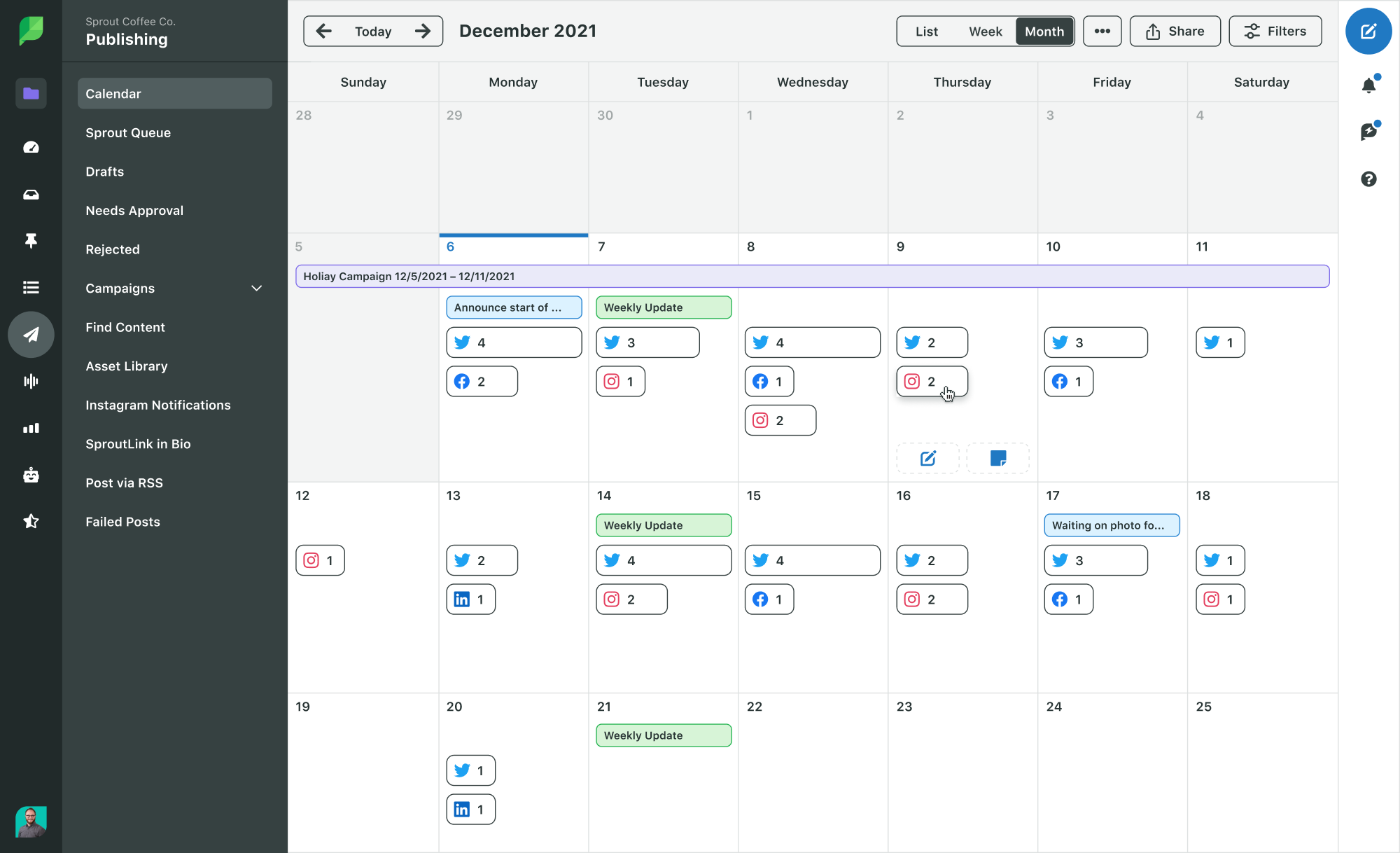
To ensure that you’re hitting up every segment of your potentially fragmented audience, it’s important that you have a strategy for promoting content between platforms. Sprout can help with that through social scheduling that not only lets you cross-promote content, but time your promotions based on optimal engagement.
2. Use social media to supplement your existing marketing campaigns
This might seem like a no-brainer, but so much of social media for retail means finding ways to mesh your social presence with existing paid campaigns.
Running a promotion? Launching a product? Time-sensitive offers? No matter what you’re pushing, you can’t afford for your followers to be in the dark or assume they’re going to learn about your promos elsewhere.
Some brands might be wary of pushing products to hard on social media. That said, the majority of consumers‘ purchasing decisions are influenced by the brands they follow.
Additionally, consistently publishing coupon codes, offers and discounts is fair game for encouraging impulse buys. If nothing else, striking product photos are prime Instagram content that doesn’t come off as “salesy” if they’re presented with some creative flair. Check out how ShopBop makes it happen.
Speaking of cross-promotion, consider that any given retailer’s email list is their bread and butter for encouraging repeat business. With an engaged email list and social following, brands have more opportunities to nurture customers and keep them in the loop about their latest promotions. Here’s how ShopBop puts their Instagram feed front-and-center via their email newsletter.
3. Gather feedback from your social customers
Of course, social media for retail isn’t just as simple as blasting offers and deals.
Although customers are more than happy to follow retailers in pursuit of a sale, your long game should be to sell your brand beyond your products.
This means figuring out your brand identity and making connections with customers. Perhaps one of the easiest and most effective ways to do so is through asking questions.
What sort of products do people want? What sort of content do they want to see? Whether through Instagram Stories or question-based posts, picking people’s brains is easier than ever. Additionally, question-based content encourages replies and interactions which are like candy to modern social algorithms.
The feedback gathered from customers can not only inform your content and product strategies but also serve as a break from purely promotional content. Retailers like Best Buy do an awesome job of asking playful questions while subtly featuring their products at the same time.
4. Dedicate time to providing social customer service
Food for thought: customer service concerns are among the top reasons that consumers engage with retailers on social media.
And so if you’re equipped to handle such concerns, you’re golden. Consider that there is no “one-size-fits-all” for customers to reach out, though. Here’s a snapshot of why customers reach out to retailers via our Sprout Social Index.
Effective social media for retail means listening and responding to customer concerns with care. This means both personalizing your replies while also responding in a timely manner. As noted in our guide to Twitter customer service, 60% of people expect a response within an hour.
Don’t think of responding to such concerns as customers being needy, though. The ability to respond with grace spells good news for your brand as you strive to keep customers around for the long-haul. Check out how Publix manages to address a reasonable concern while still scoring a “Like.”
I'm sorry for your disappointment, Lauren. Maybe one day it will return. I'll be sure to share your feedback with our teams! ☾ Lacey
Social customer service isn’t just about addressing questions and complaints. Customer care also means giving customers shout-outs to highlight their positive experiences. As noted by our data, that’s the top reason why customers reach out: capitalize on those moments and let them serve as social proof for your brand.
a wedding dress is just a dress you wear to a wedding which means we definitely make wedding dresses 😉congrats btw! https://t.co/4ibWJoVLeW
The takeaway here is that customer service can’t be an afterthought for retailers. Through consistent monitoring and social listening, you can make sure those precious mentions don’t fall by the wayside.
5. Listen for trends to influence your product and content strategies
Speaking of listening, social media retail trends are constantly changing.
Brands are constantly experimenting with new ways to engage with followers. At the same time, competitors and new products are constantly flooding any given retail space which speaks to the need for brands to have a strong pulse on their industries.
Sprout’s social listening suite includes a query builder where brands can easily monitor mentions, hashtags and industry-related keywords to better track what customers are buzzing about.
More advanced listening features in Sprout can also help retailers monitor their brand sentiment and mentions to ensure healthy, positive growth in engagement over time.
Beyond questions and concerns, your customers can be a goldmine of business intelligence on social media. It’s all a matter of making sure you’re listening, though.
6. Curate user-generated content to promote your satisfied customers
Easily one of the biggest needs when it comes to social media for retail, brands need to be on the hunt for user-generated content (UGC)
Even retail giants like Target (with nearly 4 million Instagram followers) rely on UGC to show off their products.
Customer photos are noted to increase conversions and engagement among social followers. Your customers want to talk about their latest purchases, granted you give them a chance to do so.
For example, Target encourages followers to @mention them within posts which allows followers to be featured in their feeds.
Meanwhile, Anthropologie uses the branded hashtag #myanthropologie to entice customers to post their photos.
Whether it’s for an influencer marketing campaign or simply encouraging UGC, retailers these days are expected to create their own hashtag to encourage organic promotion on behalf of their followers. Doing so provides yet another avenue for customers to engage with your brand and vice-versa.
As noted by the number of brands totally killing social media for retail, encouraging purchases directly from social media is more than possible.
However, it’s not as simple as dropping product links and walking away.
If you want to increase your social media conversion rate, you’re going to need to make shopping a seamless experience.
For example, let’s look at how easy Crate and Barrel makes shopping their Instagram feed. Their bio link call-to-action is loud and clear, as is their social-specific landing page which makes it a cinch to browse products.
Ideally, you want to keep your customers moving from Point A to Point B rather than bouncing between a bunch of links and re-directs. Even if you don’t use a third-party tool for social shopping, making your social landing pages scrollable and mobile-friendly is a must-do.
Additionally, note that social platforms are constantly rolling out new shopping and advertising features tailored for social media for retail. For example, the roll-out of Instagram checkout signals how networks are trying to make it easier for brands to encourage purchases. Here’s a snapshot of the feature from Crate and Barrel’s feed.
8. Remarket to current and former customers
Of course, we can’t talk about social media for retail without discussing paid ads.
With social algorithms seemingly cracking down on purely promotional organic posts, running ads allows retailers to appeal to customers without running the risk of spamming them.
The good news is that retailers can personalize and target their advertising like never before. Brands can run campaigns to prospect for new customers or reach out to returning customers simultaneously.
For example, Facebook and Instagram’s dynamic ads can reach former customers or folks on your email list who you’re looking to reactivate. Such ads serve as a cost-effective way to reintroduce your brand to customers and are likewise noted for their high ROI. This retargeting campaign from Gathre resulted in a staggering 91% return on ad spend.
9. Don’t forget your physical packaging
If you’re a retailer, you have a distinct opportunity to make a lasting impression on your customers in-person.
This can be done by combining your social presence with your physical packaging if possible. From stickers and business cards to quite literally wrapping up your products with your social handles, there are tons of creative ways to couple social media with in-person promotion. Here’s an awesome example from Vistaprint.
Even something as simple as a branded business card snuck into your shipped orders is a smart move. Retailers can’t be shy about promoting their social presence and in-person creatives are one of the most meaningful ways to do it.
10. Increase your customer lifetime value over time
The end-game of social media for retail is to nurture customers and encourage them to become long-term shoppers.
In other words, you can’t afford to solely focus on acquisition. Growing your follower count is nice, but ask yourself: is your social presence resulting in long-term engagement and purchases?
If someone is willing to follow your brand, they’ve already signaled their interest to make a purchase. This highlights the need to promote offers while also connecting with a diverse content calendar. As noted by the examples above, retailers have a ton of creative options available for regularly engaging their target audiences.
At the same time, think about how you can increase what your social following is worth over time.
Ramp up your efforts during the holidays where consumer spending is at an all-time high. Run influencer marketing and UGC campaigns. Try your hand at social ads.
And along the way, make sure you’re keeping a close eye on engagement via social analytics. By tracking your growth and engagement by the numbers, you can better understand what’s encouraging purchases from your followers over time.
And with that, we wrap up our guide!
How are you using social media for retail?
There’s no denying that retailers have their hands full in terms of their social presence.
But as we said, retailers have the most to gain from social media at large.
From uncovering new customers to increasing the value of the ones you already have, the amount of creative business opportunities available to retail brands on social media is seemingly endless.
And with the help of tools such as Sprout Social, brands can run and monitor their campaigns by-the-numbers to win more customers along the way.
We want to hear from you, though. What do you see as the future of social media for retail? Any challenges that you’ve faced in pursuit of more business? Let us know in the comments below!
There are many reasons you might want to run an Instagram contest, whether you’re looking to quickly grow your online presence or simply want to give back to your followers.
But there are some rules and guidelines you need to keep in mind if you want to host an Instagram contest to ensure that it’s both legal and successful.
To help make sure you put on the best Instagram contest possible, we’ve put together this guide on how to run an Instagram contest that your audience will be excited to enter and share. Let’s dive in!
Instagram contest rules
First things first, we need to go over Instagram’s rules and legalese. You may have noticed that most Instagram contests or giveaways come with an extra long caption with lots of fine print.
This is because Instagram has a lot of rules and guidelines in place to ensure they’re released from any liability in case any party doesn’t follow through with their end of the deal.
Here’s a quick summary of the most important points in Instagram’s contest rules:
You are responsible for the lawful operation of your Instagram contest.
Avoid inaccurate tagging in photos.
Include a complete release of Instagram by each entrant, as well as copy clearly outlining that your contest is in no way, shape or form sponsored by Instagram.
Instagram will not assist you with your contest.
You run an Instagram contest at your own risk.
You can read the full policy here, but basically, Instagram is making sure you know they’re not liable, and that you make sure your followers know that Instagram is not liable, regardless of how your contest pans out.
Instagram contest ideas and examples
So you’re ready to start planning for your Instagram contest. But how exactly do you want to have people enter, and what are the benefits for your overall marketing strategy? There are several different types of contests you could run, so we’ve put together a list of our favorites for you to choose from.
1. Like, comment and follow
One of the most popular methods of entry is to have people like your photo announcing your Instagram contest, leave a comment and follow your account in order to gain entry.
Here’s a great example of this type of Instagram contest put on by CAUSEBOX.
Simply name your prize, lay down the ground rules and watch the entries fly in. You can ask people to comment with why they should win, nominate someone to win or simply tag a friend to spread the word.
However, that last option is a great contest idea all on its own–read on for more ways to make tagging friends in contest work effectively.
2. Tag a friend
Want to really get the word out about your Instagram contest? Ask people to tag a friend when they enter! Users can tag as many friends as they like in order to get even more entries.
Then, those users are likely to enter and tag some of their own friends, creating a ripple effect of awareness around your contest and brand.
You can also host a tag a friend Instagram contest in order to ask your followers to nominate someone who deserves a prize, like in this example below, run by doll10beauty.
In this example, they asked followers to tag a doctor, nurse, grocery store worker or another essential worker who has been going to work non-stop through the COVID-19 pandemic.
This is a great way to thank people who have been working hard to help others, as well as grow your customer base at the same time.
3. User-generated content
If you’re looking to put together a campaign around gathering user-generated content (UGC) to share online, creating an Instagram contest around that concept can be a great way to do it.
Ask your audience to share a photo onto their feed using a specific hashtag or tagging your business so that you can easily find all of the entries in one place.
Not only does this reward your customers for helping you out, but it gives you an entire arsenal of user-generated photos to share on your feed for future content planning.
4. Collaboration
Another great way to broaden your audience is by collaborating with a similar brand involved in a contest together.
If you go this route, users will then have to follow each brand going in on the contest together in order to enter. Here’s an example of what this might look like from Ring Concierge and Elemis.
Many influencers also host collaborative giveaways like this, meant to help their followers discover new brands and bloggers, and vice versa.
If you’re working to grow your Instagram presence, a collaborative contest or giveaway might be your best bet.
5. Instagram stories
While Instagram contests are all about giving back to your audience, there are important benefits for your overall Instagram marketing strategy too: brands can garner a lot of attention and generate a bigger audience through them as well.
Having your audience share a post on their Instagram Stories as a form of entry can be another great way to get the word out there.
It’s super easy for users to share posts to their Instagram Stories, so asking for something like this as an entry isn’t asking too much of your audience, and can be a great way to spread the word.
How to run an Instagram contest
Now that we’ve covered a few great Instagram contest ideas, let’s take you through a quick step-by-step guide on how to actually run your contest or giveaway.
1. Define your Instagram contest objective
Before anything else, you need to make sure you define the overall objective of your Instagram contest so that you know how to determine whether or not it was successful in the end.
Are you trying to engage your audience more in your content? Are you aiming to generate a larger following? Is your plan to build a library of UGC to share on social media?
Whatever your main goal or objective is, keep it in mind throughout your entire contest planning process so that everything you do makes sense for your end goal.
2. Choose your entry method
How will users enter your Instagram contest? Think back to the examples we shared above. Which falls most in line with your main goal or objective?
Be sure that whatever you choose, it’s easy for people to enter your contest. No one is going to enter a contest that requires them to do a lot of work–people want your entry process to be simple and easy.
Once you decide the best entry method for your contest, it’s time to start planning out the rest of the details.
First, determine how long your Instagram contest will last. How many days will your audience have to enter? Make sure that deadline is predetermined and that you clearly let your audience know when entering will end.
Second, are you going to use a hashtag for your campaign? Whether you have people post photos with that hashtag or ask them to use it in the comments, creating a campaign-specific hashtag that no one else is using is a good idea. This way, you’ll be able to tell the contest entries from regular posts about your brand.
Third, what is the theme for your contest? This is especially important for UGC-focused contests. You want to make sure your audience knows what types of photos you’re looking for them to share.
And finally, how will you notify the winner? Will you tag them in a comment? Share a new post? Message them? Tag them in an Instagram story? This is something you need to have planned beforehand and let your entrants know early on.
3. Select a prize
Before launching your contest, you need to select a good prize. You want this to be specific to your target audience, and not something that anyone would want to win.
For example, a cash prize or an iPad or iPhone could apply to anyone, whereas a gift card or product from your shop would appeal only to the people who would buy from you anyways. This helps engage your target audience further and can also help your awareness goals–if the winner posts their own photos of the products they received from your contest, you’ll get additional awareness and reach out of your efforts.
4. Design your campaign assets
Put together graphics to promote your Instagram contest so that you can cross-promote it on various platforms, in your email newsletter, on your website and more.
Be sure to create imagery both for your Instagram feed and to share on your Instagram Stories to increase the number of followers who see the contest early on, giving you plenty of time to collect entries.
5. Pinpoint who will manage your Instagram contest
You don’t want to have too many cooks in the kitchen, so pinpointing who will manage what on your Instagram contest is a good idea.
You can also utilize Sprout Social’s team collaboration tools to ensure that everything runs smoothly and no entries are missed.
Just assign various comments and posts to the corresponding team members to ensure nothing gets left behind. You can also tag posts as related to a specific contest, so that it’s easy to sort out these mentions and posts from other types like customer service-related messages or posts relating to a different campaign.
6. Launch your Instagram contest
You’re ready to go! Launch your Instagram contest, wait for the entries to roll in and announce your winner!
Make sure to check your metrics to see how your Instagram contest performed against your initial goals. If your contest was a success, consider adding regular contests and giveaways into your social media strategy.
Create your next Instagram contest today
Now that you know how to run a contest on Instagram, it’s time to get started. Pinpoint your goals, decide the best way to gather entries and start giving away fun prizes to your audience.
Need more visibility on LinkedIn? Wondering how to get employees involved with your LinkedIn content strategy? In this article, you’ll discover four ways to help your employees share more company content with their personal networks on LinkedIn. Why Encourage Employees to Share Company Content on Your LinkedIn Page? Getting your colleagues involved with your LinkedIn […]